The revenue a customs administration loses is rarely stolen at the gate. It is declared away, one line at a time, and most of it is never looked at again.
I started as a New Zealand Customs officer in 1982, classifying and valuing goods at the border. In the early 1990s, as a revenue and valuation analyst, I helped build New Zealand Customs' first electronic, risk-based Post Clearance Audit selection system. Since then I have designed or tested PCA selection systems for administrations in Angola, Laos, the Philippines, Saudi Arabia and Nigeria.
The lesson has been the same everywhere. Administrations rarely lack audit powers or willing auditors. What they lack is a defensible way to decide which declarations deserve an auditor's time, and evidence strong enough to recover the money once they find it.
Where the money actually goes
The leakage I have investigated has come through the same few doors in every country.
In Nigeria, for the World Bank, I analysed large irregularities in revenue flows across oil, petroleum products and vehicles. In Angola I advised on border controls covering about US$3.3 billion in collections, including PCA selection for petroleum products. In Laos I am investigating revenue leakage on imported liquid fuels, both at import and after it. My official 2023 report put the value of oil and fuels smuggled into Laos at between US$780 million and US$1.2 billion a year. In the Philippines I assessed the scale of operational and post-clearance revenue leakage at the Bureau of Customs and designed the audit controls to contain it.
The mechanisms rarely change:
- Undervaluation: a declared price well below what the goods actually trade for.
- Non-tariff measure (NTM) abuse: an exemption, licence waiver or preferential treatment claimed that the goods do not qualify for. This is the second most common method I see.
- Misclassification: a lower-duty tariff code applied to the wrong goods.
- False origin: a preferential origin claimed that the trade records do not support.
- Mis-description: goods described as something they are not, so both code and value are wrong.
- Abuse of exemptions: low-value and relief thresholds used to move dutiable goods through untaxed.
NTM abuse deserves more attention than it gets. From 2017 to 2025 I worked for UNCTAD mapping non-tariff measures against HS codes, covering every Pacific island country at different times, as well as Thailand, Laos, Vietnam and South Africa. A single NTM can span many headings, and the codes it touches in machinery, organic chemistry, pollutants and living organisms are some of the most obscure in the tariff. The trap is that a declaration can carry the correct HS code and still be wrong: the code is right, but the NTM exemption or treatment applied to it is not. A classification check alone will clear that line.
The independent evidence now matches what practitioners have long seen on the ground. A World Bank study matched 7,461 containers shipped from France to Madagascar by container number. It found tariff revenue would have been 24 percent higher if imports had been declared as France recorded them. Existing customs value adjustments recovered only 1.8 percent of that loss, and five of 602 importers accounted for three-quarters of it (Anne, Chalendard, Fernandes, Rijkers and Vicard, "Containing Tariff Evasion," World Bank Policy Research Working Paper 10606, 2023).
That last figure is the one every PCA manager should remember. The loss is concentrated, which means it can be found.
Why Post Clearance Audit is where revenue is recovered
PCA is the stage where lost revenue actually comes back. At the frontier, an officer has minutes per consignment and the goods are waiting. In PCA the administration has time, access to the trader's books, and the legal power to reassess and collect duty years after release. The WTO Trade Facilitation Agreement pushes this way too: Article 7.4 requires risk management that concentrates control on high-risk consignments, and Article 7.5 makes post-clearance audit the backstop that lets everything else clear quickly.
In my experience, PCA units underperform for three reasons:
- Selection is weak. Audit lists are built from last year's list, from tip-offs, or from crude rules that flag the same large, compliant importers every cycle.
- Evidence is thin. An auditor who suspects undervaluation often has no market price to put against the declared one, and a reassessment without a defensible basis collapses on appeal.
- Volume has outrun people. Tariff schedules change constantly and low-value shipments now arrive in the millions a day. No administration can staff its way through that.
None of these is a legal problem. They are data problems, and they are now solvable.
What a modern revenue assurance tool brings
BorderHQ's BorderRev is the kind of tool I would have wanted in Luanda, Manila or Vientiane. It reads each declaration the way the administration already holds it: commodity code, description, origin, value and quantity. It then checks every line three ways and returns a finding with the evidence attached.
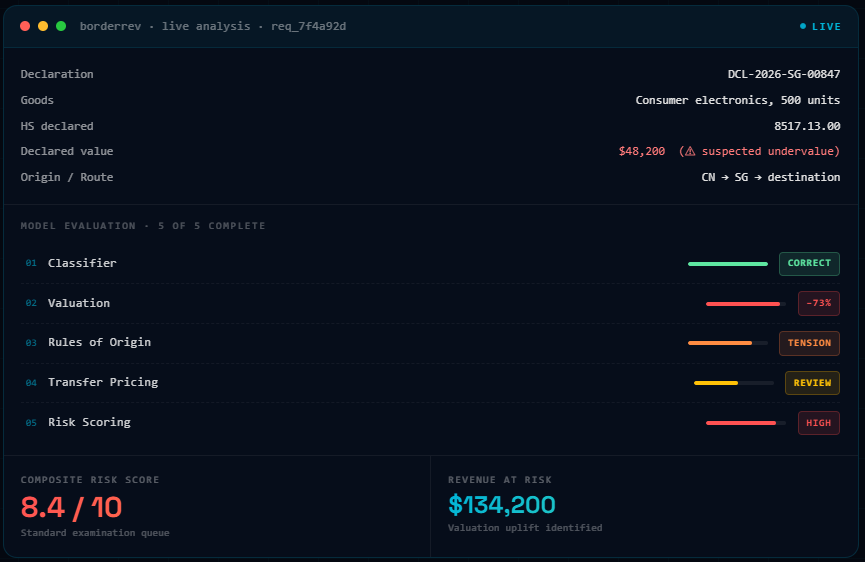
- Classification, cited to law. Every finding on a declared HS code names the Chapter or Section Note, the General Interpretative Rule or the ruling behind it. Five tiers of checks sit behind this, from an exact match with past declarations up to a reasoning step for novel or contested goods.
- Valuation, following WTO order. The declared transaction value (Method 1) is tested against market evidence using Method 2 (identical goods), Method 3 (similar), Method 4 (deductive) and Method 6 (fall-back), in that sequence. A finding needs three agreeing price observations or one strong named source. It states the method, the confidence level and the matched transactions.
- Origin, checked against two countries' records. The declared origin is tested against UN Comtrade: what the destination recorded importing, what the exporting country recorded shipping, and what that country sold worldwide. Implausible origins are flagged with ranked alternatives, and the origin determination stays with the officer.
- Routing by confidence. High-confidence errors go to a priority audit queue, medium-confidence ones to the standard queue alongside other risk signals, and ambiguous lines to a specialist. The routing decision stays inside the administration's existing selectivity process.
- A portfolio view. Because every line is scored, commissioners see which chapters, trade lanes, preference regimes and traders carry the most revenue risk, and how that changes over time.
- Data sovereignty. The internal pricing model runs on infrastructure the administration hosts. Only a cleaned, anonymised goods description is ever searched externally.
- Legal versioning. Every tariff edition and agreement carries its effective date. A finding keeps the edition it was assessed under, so a later change does not quietly reopen it.
The track record matters. An earlier version of this technology recovered US$115 million in evaded revenue for Bahamas Customs in four months, a case the World Customs Organization published as disruptive technology (WCO News, Issue 99, 2022).
The same cited-evidence approach extends naturally to non-tariff measures. Checking every declared exemption, licence and treatment against the NTMs that actually apply to that HS code, and citing the measure behind each finding, would close the gap that a classification check leaves open.
How I would put it to work: a PCA recovery framework
A tool only recovers revenue when it sits inside a working audit process. Here is how I would build that process around BorderRev in an administration starting from scratch.
- Size the problem before touching any data. Start with a country revenue risk report built from published sources: mirror statistics, the tariff schedule, preference agreements and low-value volumes. It shows which chapters, lanes and preference regimes deserve attention. That lets the PCA unit write its annual audit plan on evidence rather than habit.
- Look back at history first. PCA works on goods already released, so the richest seam is the administration's historical declarations within its statutory audit period. Scoring several years of past declarations shows what was missed, and it gives an early estimate of recoverable revenue before new controls are designed.
- Audit the trader, not the line. Rank findings by revenue foregone, then cluster them by importer. When five importers out of 602 account for three-quarters of the loss, the audit list writes itself. One well-prepared audit of a repeat undervaluer is worth a hundred random desk checks.
- Match the intervention to the confidence. High-confidence cited findings go to desk review and a request for documents. Patterns across a trader's portfolio justify a full field audit of books and payments. Ambiguous lines go to a classification or valuation specialist. Low-risk traders are left alone, which is itself a trade facilitation result.
- Build a file that survives appeal. Each finding already carries its legal note, its WTO valuation method with matched transactions, or the two countries' Comtrade filings. The auditor adds the trader's invoices, contracts and payment records. The valuation and origin decisions remain the officer's, under the law, and are now backed by evidence the trader's own counsel can inspect.
- Recover and encourage disclosure. Issue reassessments, collect duty and penalties, and offer a voluntary disclosure route. In practice, a credible audit programme makes the sector correct itself, and that is where the larger revenue gain comes from.
- Feed results forward. Confirmed findings become risk profiles at the frontier, so the same scheme is stopped before release next time. Over-declarations get treated as compliance errors to fix with the trader, not as fraud.
- Measure what matters. Track hit rate, revenue assessed against revenue collected, appeal outcomes and time from selection to recovery. Those numbers are what a Commissioner, a Minister and a donor will ask for.
This is the discipline I have tried to bring to PCA design for more than thirty years. The difference now is that the selection and the evidence no longer depend on how many analysts an administration can afford.
The revenue is still there
Customs remains a large share of the revenue base in developing economies. The IMF puts it at around 37 percent of total revenue collection in low-income and developing countries. Every point of leakage recovered is money for schools, roads and hospitals that does not need a new tax to raise it.
Most of what was declared away over the last few years can still be recovered within the audit period. The administrations that act first will be the ones that ask which of their declarations are worth an auditor's time, and can prove the answer.
For customs leaders who want to see where their own exposure lies, BorderHQ prepares a free country revenue risk report from published data, and runs short pilots on an administration's own anonymised declarations. Contact info@borderhq.ai or visit BorderHQ.

Paul Schmidt
Paul is a former New Zealand Customs fraud and valuation analyst and a CISA-certified information systems auditor. He has advised customs administrations and donors including the World Bank, Asian Development Bank and UNCTAD in more than 25 countries on risk management, post-clearance audit and revenue assurance.